
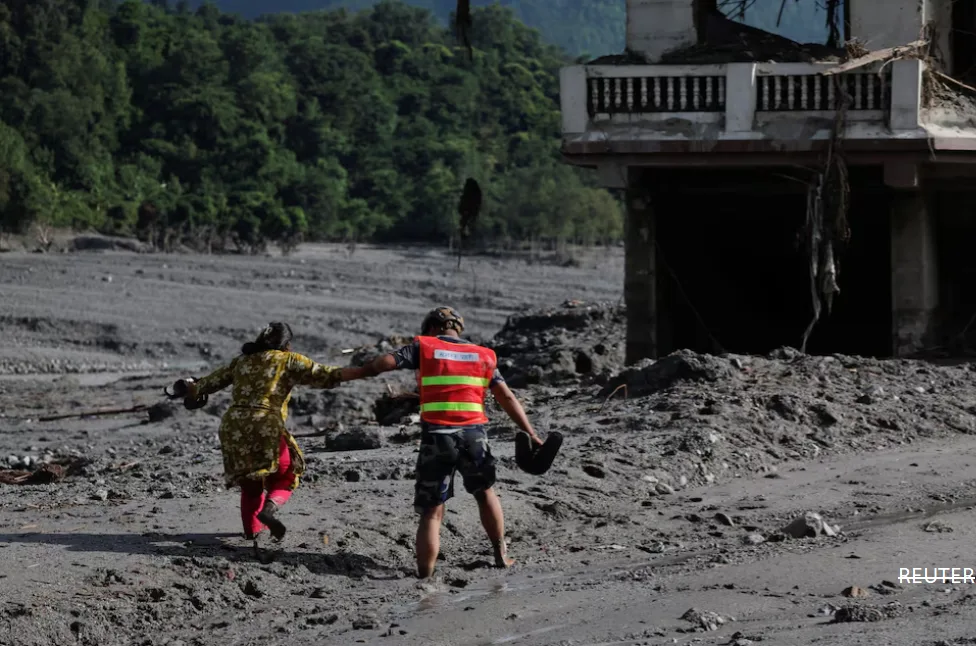
Nepal, China Resume Flood Rescue Operations as Glacier Lake Threat Eases; Death Toll Tops 500
NUWAKOT, Nepal, Aug. 28 (Reuters) — Nepal and China resumed rescue operations on Friday after temporarily suspending them over fears that a rapidly rising glacial lake could trigger another devastating flood in the Himalayas. The disaster caused by a glacier collapse on Wednesday has killed 547 people in Nepal and five in China's Tibet, while nearly 1,000 people remain missing across the two countries, according to authorities. A massive torrent of rock, ice, mud and debris swept through mountain valleys and river systems following the collapse, destroying homes, roads, bridges and other infrastructure. The disaster also created a large lake upstream, raising concerns that a sudden breach could send another surge of water downstream.
Rising lake triggers fresh alarm
Authorities said the lake contained more than 2.5 million cubic metres (90 million cubic feet) of water by Friday, compared with an estimated 1.5 million to 2 million cubic metres a day earlier.
Water began overflowing into the Lhende Khola river before flowing into the Trishuli River, prompting authorities to issue warnings and temporarily suspend rescue operations. Chinese rescue workers and vehicles were also moved to safer locations as a precaution, state broadcaster CCTV reported. The operations resumed after officials determined that the immediate threat had eased. "By noon, as the risk posed by the upstream dammed lake was deemed manageable, rescue operations for the Gyirong mudslide disaster quickly resumed and were stepped up," CCTV reported.Nepalese army spokesperson Raja Ram Basnet told Reuters that rescue teams had stopped work temporarily after the flood warning but later determined that the water level had risen by only about two feet (0.6 metres).
Villages destroyed, hundreds still missing
Wednesday's floods devastated villages and valleys along a major route connecting Nepal's capital Kathmandu with Lhasa in Tibet. The route is also widely used by trekkers and religious pilgrims.At least 540 of those reported missing are foreigners, many of them Indian Hindu pilgrims travelling toward Mount Kailash and Lake Mansarovar in Tibet. Rescue teams have been using helicopters to search remote areas, evacuate survivors and deliver emergency supplies to communities cut off by the destruction of roads and bridges. Emergency workers, including teams using sniffer dogs, have recovered dozens of bodies carried downstream by the floodwaters.
China orders stronger monitoring
China's top leadership called for intensified rescue operations and stronger monitoring of glacier lakes, landslides and other geological hazards. The Politburo, chaired by President Xi Jinping, directed authorities to develop scientific search-and-rescue plans and make every effort to locate missing Chinese and foreign nationals, state news agency Xinhua reported. The leadership also called for increased emergency assistance to Nepal and greater international cooperation on disaster response. Chinese Premier Li Qiang visited the disaster-hit Gyirong area on Thursday, highlighting the seriousness with which Beijing is treating the disaster.
Chinese rescue teams had struggled to reach the worst-hit areas because debris had blocked the main road leading to the Gyirong border crossing. Video footage from Wednesday showed huge waves of muddy water and debris sweeping through buildings and engulfing people attempting to escape. Chinese authorities said 558 people were missing in Gyirong County, including 260 foreign nationals. Five deaths had been confirmed in Tibet.
Survivors describe devastation
In Nepal, rescue teams have been working around the clock to locate survivors and recover victims. Dibga Tamang was among the people rescued from the Rasuwa area on Thursday. She was airlifted with three others to an army camp in Nuwakot. "All of our people have gone. They are dead," Tamang said, describing the devastation in her community. Army bases have become gathering points for relatives searching for information about missing family members. Bodies recovered from the disaster have been taken to military facilities, while lists of rescued people have been displayed to help families establish the whereabouts of relatives.
Families around the world await news
Relatives of missing foreign nationals have been desperately seeking information. Sneha Sudhir, whose husband was among a group of men travelling from Nepal toward Mount Kailash, said families were contacting officials, politicians and relatives in the United States and India in an effort to locate their loved ones. Several Americans from northern Virginia are among those reported missing. U.S. President Donald Trump said Washington had offered assistance to Nepal, describing the destruction as unprecedented. "Nobody's ever seen anything quite like that," Trump said, adding that the United States was prepared to provide aid requested by Nepalese authorities.
Nepal declines foreign search-and-rescue teams
Despite offers of assistance from several countries, Nepal has said it does not currently require foreign search-and-rescue teams. South Korea has already sent a rapid-response team to Kathmandu, but the team has not been deployed because Nepal has yet to establish a mechanism for accepting foreign rescue personnel, South Korea's foreign ministry said. According to Nepalese media, India, China, the United States, Britain, Japan, South Korea, Sri Lanka and Bangladesh have offered to send search-and-rescue teams. For now, Nepalese authorities and local emergency services continue to lead the search as the country confronts one of its deadliest recent natural disasters.

Latest Posts